
Why the providers winning contracts in 2026 aren’t just delivering great care, they’re proving the difference they make.
If you’re a social care provider preparing for your next tender, here’s a question worth reflecting on: when did you last look at how your bid scores on social value?
Because here’s what we’re seeing across the hundreds of tenders we support every year at Insequa, social value is no longer a box-ticking exercise buried at the end of your submission. It has become one of the most decisive factors in whether you win or lose and it needs to be reflected strongly throughout your entire bid. And yet, it remains one of the most underestimated and poorly evidenced sections in the vast majority of bids we review.
That’s a problem. But it’s also a significant opportunity for providers who are willing to get this right.
The Landscape Has Changed, Dramatically
Social value has been part of public sector procurement since the Public Services (Social Value) Act 2012, which placed a duty on commissioners to consider how the services they procure could improve the economic, social, and environmental wellbeing of their area. For years, though, “consider” was the operative word. Many commissioners paid lip service to it. Many providers treated it as an afterthought.
That era is over.
The Procurement Act 2023, which came into force on 24 February 2025, has fundamentally shifted the landscape. The Act replaces the old principle of awarding contracts to the “Most Economically Advantageous Tender” (MEAT) with the “Most Advantageous Tender” (MAT). That single word change, dropping “economically”, is enormously significant. It means commissioners are now explicitly empowered, and expected, to evaluate bids on the basis ofbroader public benefit, not just cost and quality in the traditional sense.
Alongside the Act, the Government introduced a new National Procurement Policy Statement (NPPS) that contracting authorities must legally “have regard to” when making procurement decisions. The NPPS ties procurement directly to the Government’s strategic missions, including economic growth, tackling inequality, supporting SMEs and voluntary organisations, and combating climate change. Social value is woven throughout.
For central government departments, the updated Procurement Policy Note PPN 002 mandates a minimum 10% weighting for social value in tender evaluations, and authorities are free to go higher. We’re already seeing local authorities applying weightings of 20% to 30% in social care tenders. Some are now assessing what they call “organisation-wide social value maturity,” looking not just at what you promise for a specific contract, but at how deeply social value is embedded across your entire operation.
In practical terms, this means social value can be worth as many marks as, or even more than,entire quality sections of your tender. If you’re not treating it with that level of seriousness, you’re leaving points on the table. Points that could be the difference between winning and coming second.
Why Social Care Providers Are Uniquely Positioned, But Often Fail to Show It
Here’s the irony that we see time and again in our work at Insequa: social care providers are, by their very nature, organisations that deliver enormous social value every single day. You support vulnerable people to live with dignity and independence. You employ locally. You train and develop your workforce. You connect people with their communities. You work alongside the NHS, local authorities, and voluntary organisations to improve lives.
And yet, when it comes to articulating this in a tender, many providers struggle. The social value section is often the weakest part of an otherwise strong submission. We see vague commitments with no measurable outcomes, generic statements that could apply to any organisation in any sector, and a disconnect between what providers actually do and what they write on paper.
The problem isn’t that you lack social value. It’s that you haven’t built the framework to define it, quantify it, and present it in a way that commissioners can score.
What Commissioners Actually Want to See
Having supported over 4,500 tenders across the social care sector, we have a clear picture of what commissioners are looking for when they evaluate social value. It comes down to three things: specificity, measurability, and local relevance.
Specificity means moving beyond aspirational statements. Rather than saying “we are committed to supporting local employment,” commissioners want to know exactly what you will do, how many apprenticeships you will create, how many work placements you will offer, what training programmes you will deliver, and over what timeframe.
Measurability means every commitment needs an outcome that can be tracked. Commissioners are under increasing pressure to demonstrate that public money delivers tangible benefits. Under the Procurement Act 2023, contracts over £5 million now require at least three published Key Performance Indicators, and many authorities are embedding social value KPIs as standard even in smaller contracts. If your commitments can’t be measured, they can’t be scored, and they won’t help you win.
Local relevance is perhaps the most important and most frequently missed element. Every local authority has its own strategic priorities, whether that’s tackling youth unemployment, reducing health inequalities, addressing loneliness and isolation, or meeting net-zero targets. The providers who score highest on social value are those who have done their homework, who understand the specific needs and priorities of the area they’re bidding into, and who tailor their social value offer accordingly. A one-size-fits-all social value statement simply won’t cut it in 2026.
The Three Pillars You Need to Address
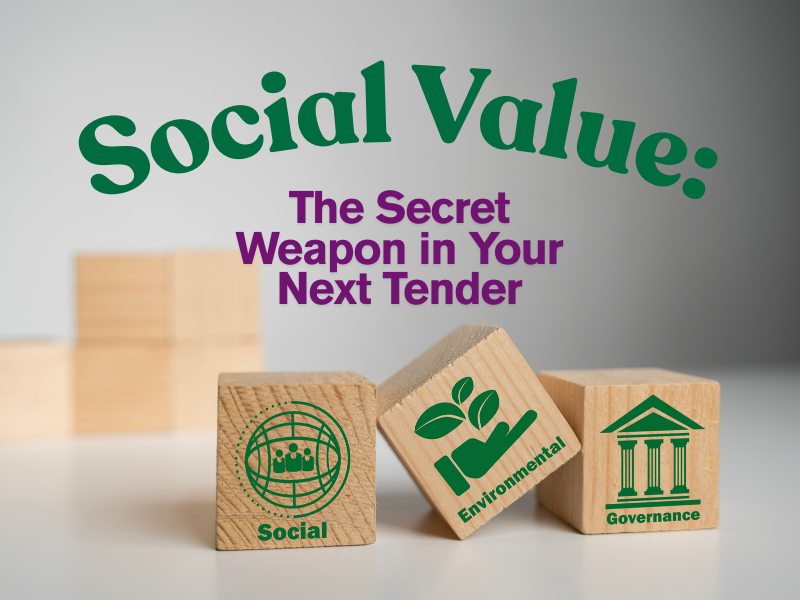
The Government’s Social Value Model, updated under PPN 002, is structured around five missions and eight outcomes. But at its core, social value in procurement sits across three interconnected pillars that every social care provider should be addressing.
- Social. This is where your core strengths as a care provider naturally sit, but you need to go further than your service delivery. Think about how you tackle inequality, create opportunities for underrepresented groups, support mental health and wellbeing in your workforce and community, and engage with local voluntary organisations. Commissioners want to see that your presence in their area creates a ripple effect of positive change beyond the people you directly support.
- Economic. This is about the contribution you make to the local economy. How many local people do you employ? Do you recruit from disadvantaged groups? What does your supply chain look like, are you supporting local SMEs and social enterprises? Do you offer apprenticeships, traineeships, or career development pathways? Commissioners under the new NPPS are specifically required to consider how procurement can support SME and VCSE participation, so demonstrating a commitment to local economic impact is more important than ever.
- Environmental. This is the area where we see the biggest gap for most social care providers, and it’s growing in importance rapidly. Many public sector contracts now require a Carbon Reduction Plan as part of the submission. Even where it’s not mandatory, demonstrating environmental awareness and a credible route toward reducing your carbon footprint will strengthen your bid. This means understanding your Scope 1, Scope 2, and Scope 3 emissions, having a realistic reduction strategy, and being able to show how you’ll report on progress. The UK’s 2050 net-zero target isn’t abstract, it’s being translated into procurement requirements right now.
Social Value Is a Strategy, Not a Section
The most important shift we encourage our clients to make is to stop thinking about social value as a section of a tender and start thinking about it as an organisational strategy.
The providers who consistently win on social value aren’t the ones who scramble to write something compelling at bid stage. They’re the ones who have already done the groundwork, who have a social value policy embedded across their organisation, a named social value lead at board level, clear governance structures, and an evidence base they can draw on for every submission.
This is where the real competitive advantage lies. When social value is part of how you operate, not just how you bid, it shows. Your commitments are more credible. Your evidence is more robust. Your language is more confident. And commissioners can see the difference instantly.
It also means you can respond more quickly and effectively when tenders arise, because you’re not starting from scratch each time. You have a social value framework, a library of measurable commitments, and a track record of delivery that you can tailor to each opportunity.
Getting Started: Practical Steps You Can Take Today
If you recognise that your social value approach needs strengthening, here are five steps to begin building a more competitive position.
- Audit what you already do. Most social care providers are delivering far more social value than they realise. Start by mapping out everything your organisation contributes, from local employment and training to community engagement, partnership working, environmental practices, and health and wellbeing initiatives. You’ll likely find you have a stronger story than you think; you just haven’t captured it yet.
- Research your commissioners’ priorities. Before you bid into any area, study the local authority’s strategic plan, health and wellbeing strategy, and any published procurement priorities. Understand what matters most in that community, and build your social value offer around it. This level of tailoring consistently scores higher than generic submissions.
- Quantify your commitments using SMART objectives. Every social value promise should be Specific, Measurable, Achievable, Relevant, and Time-bound. Instead of “we will support local employment,” commit to “we will create three paid apprenticeship positions for local residents within the first 12 months of the contract, with structured training leading to a Level 2 qualification in Health and Social Care.”
- Develop your Carbon Reduction Plan. If you don’t already have one, this is becoming increasingly urgent. Even if a particular tender doesn’t mandate it, having a credible CRP ready demonstrates environmental maturity and positions you well for the growing number of contracts that do require one. Understand your emissions across all three scopes and set realistic, evidenced reduction targets.
- Embed social value in your governance. Appoint a social value lead, ideally at board level. Create a social value policy that sits alongside your other strategic documents. Build reporting mechanisms so you can evidence delivery against your commitments,not just at tender stage, but throughout the life of the contract. This is exactly the kind of organisational maturity that commissioners are starting to look for.
The Opportunity in Front of You
Social value is no longer a nice-to-have. Under the Procurement Act 2023 and the new NPPS, it has become a scored, weighted, and monitored component of public sector procurement, and its influence is only growing. For social care providers, this represents an enormous opportunity. You are already organisations built on the principle of making a positive difference to people’s lives. The challenge, and the competitive advantage, lies in your ability to articulate, quantify, and evidence that difference in a way that wins contracts.
The providers who invest in this now will be the ones who thrive as the new procurement landscape beds in through 2026 and beyond. Those who continue to treat social value as an afterthought will increasingly find themselves losing out to competitors who don’t.
How Insequa Can Help
At Insequa, we work exclusively in social care, and social value is one of our specialist areas. We help providers across the sector to define, develop, and strengthen their social value strategies, not just for individual tenders, but as an embedded part of how they operate and grow.
- Our social value services include strategy development, social value training, Carbon Reduction Plan creation, governance and leadership support, and integration of measurable social value commitments into your tender submissions. We also offer two free downloadable guides, our comprehensive Social Value Guide for Adult Social Care Providers and our Carbon Reduction Guide, to help you start building your approach today.
- With over 4,500 tenders delivered, an 80% win rate, and 148+ years of combined social care expertise across our team, we understand what commissioners are looking for and how to help you stand out.
Ready to strengthen your social value strategy? Call our team on 0115 896 3999 or visit insequa.co.uk/social-value-social-care to book a free discovery call.