Start by Checking Your PIR Access and Service Details
Before you begin planning your PIR submission, one of the first things to do is to check that you can access the online form and that the registration details for ‘Your Service’ and ‘Your Organisation’ are accurate and up to date on page 2 of the form.
Realising that there are basic errors on the day of submission will cause you a great deal of stress, which is easily eliminated by performing a quick check at the beginning of the process.
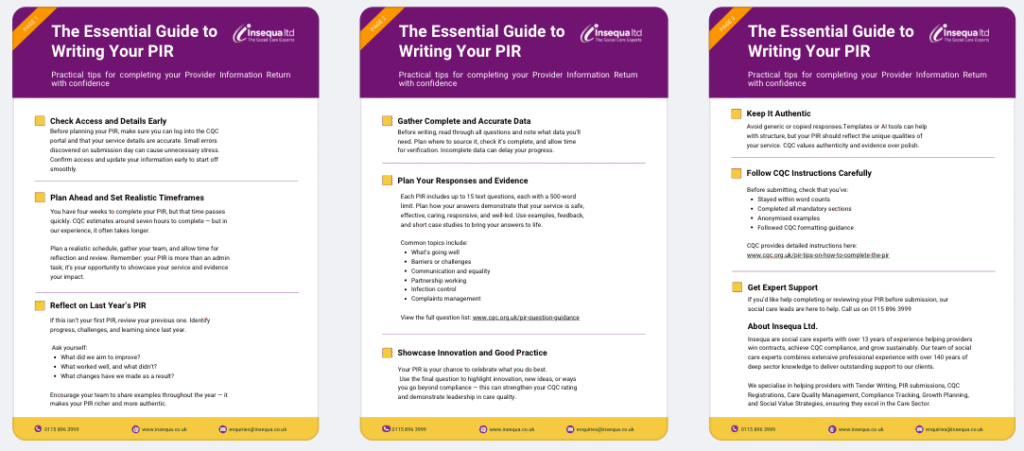
The Essential Guide to Writing Your PIR – Get Support
Plan Your Time and Set a Realistic PIR Schedule
Ensure that you schedule time to complete the PIR within the 4-week timeframe given and don’t leave it until the last minute. Whilst 4 weeks may seem like plenty of time, it can be surprising how quickly the deadline approaches, especially in a fast-paced social care environment. CQC states the average time to complete the PIR form is approximately 7 hours, however in our experience of completing many of these for our clients, this is an underestimation.
The PIR marks the beginning of the inspection process. It is not a simple tick box exercise; it is your initial opportunity to highlight your strengths and evidence how your service makes a positive difference to the lives of the people who receive your support.
By planning a realistic timeframe, you can ensure that you are able to gather the information you need and create well-evidenced responses to the questions asked, establishing a positive introduction to your inspection visit.
Gather Accurate Data Before You Start Writing
If this isn’t your first PIR, take some time to look back at last year’s submission. Each organisation is required to produce a new PIR every year, and the CQC won’t want to see a repeat of last year’s content – they’re looking for evidence of improvement and progress.
Reflect on what’s changed within your service over the past 12 months: perhaps you’ve introduced new technology or software, refined internal processes, or strengthened your approach to recruitment, retention, or staff training. This is your opportunity to show how your service continues to develop and evolve. Avoid copying and pasting from previous years; instead, present your service with fresh eyes and demonstrate meaningful growth and good practice.
Ask yourself:
- What did we say we were going to do last year, and how has that gone?
- What worked well?
- What didn’t go to plan, and what did we learn from that?
- How have we adapted or improved our systems, care delivery, or culture since then?
- What have we learnt, and what have we improved as a result?
Establishing a system of reflection throughout the year – for example, reviewing progress monthly can make preparing your PIR much easier and ensure nothing is missed. It also helps you gather real, recent examples from staff and service users, rather than relying on memory when the time comes to complete your return.
Encouraging your team to share what’s changed and improved in the last 12 months provides rich evidence for your PIR and demonstrates your commitment to continuous learning and quality improvement.
Read the questions and identify the data you will need.
Some of the questions are simple number fields but even these can be difficult to answer if you are working with incomplete or difficult to collate data.
A large part of the time you will need to allocate to your PIR focuses on gathering information. You need to consider where you will find your data and plan how long it will take to collate it.
Once you have your data, allocate some time to check that it is complete and correct because if information is missing, this can mean more valuable time spent in finding what you need.
Plan Your PIR Responses and Supporting Evidence
Think about the information you will include in the answers to your questions and the evidence you will need to support your responses. Consider how each of your answers show CQC that you are safe, effective, caring, responsive and well-led and provide brief case study examples, evidence of outcomes and feedback to illustrate your points.
There are potentially 15 text-based questions within the return, each of which has a 500-word limit. PIR questions vary depending on the type of service you deliver and the PIR you are required to complete, but most contain questions around:
- What you feel is going well.
- What barriers you are experiencing.
- How you meet the communication needs of your clients.
- How you meet equality standards.
- How you work in partnership with other organisations.
- How you ensure effective infection control.
- How you manage complaints.
You can find a full list of the PIR questions for each service type on the CQC website: https://www.cqc.org.uk/pir-question-guidance
Highlight Innovation and Examples of Good Practice
Consider areas of innovation and good practice that you can highlight – is there anything you are doing particularly well, that exceeds requirements or new ideas that are proving successful? These can help achieve Good and Outstanding ratings, so it is important to highlight these. The final question in the PIR is your 500-word opportunity to draw your Inspector’s attention to anything you are doing well, so be sure to make the most of this section.
Avoid cut and paste or generic AI responses.
Your PIR should be an accurate reflection of your service – it’s your opportunity to share the excellent work you do with the regulator and to showcase what makes your organisation unique.
With time pressures, writer’s block, or uncertainty about where to start, it can be tempting to look for example PIRs or turn to AI for help. While these tools can be useful for sparking ideas or structuring your writing, what truly matters is that your PIR communicates the individuality of your service and the real difference you make to those you support.
Make sure the information you include is up to date and accurate. Check any data drawn from electronic systems carefully, particularly if you’ve introduced new software or made system changes in the past year. While electronic tools can help collate information, they can’t create the narrative that shows your ability to provide consistent, well-managed care – nor can they describe the improvements and positive changes you’ve made over the last twelve months. That story is yours to tell, and it’s what brings your PIR to life.
Follow CQC PIR Requirements and Technical Guidance
CQC have include a series of tips for writing a PIR, which includes instructions and technical requirements here https://www.cqc.org.uk/pir-tips-on-how-to-complete-the-pir
To ensure that you submit a complete return, make sure you:
- Stick to the word counts given.
- Ensure ALL mandatory responses are completed.
- Ensure examples that support responses are anonymised to protect personal information.
- Follow the formatting requirements.
If you need help completing your PIR, or want an expert pair of eyes to review your draft before submission, give us a call on 0115 896 3999 or use our contact form here, and one of our social care leads will be happy to help.
Download Quick Guide: